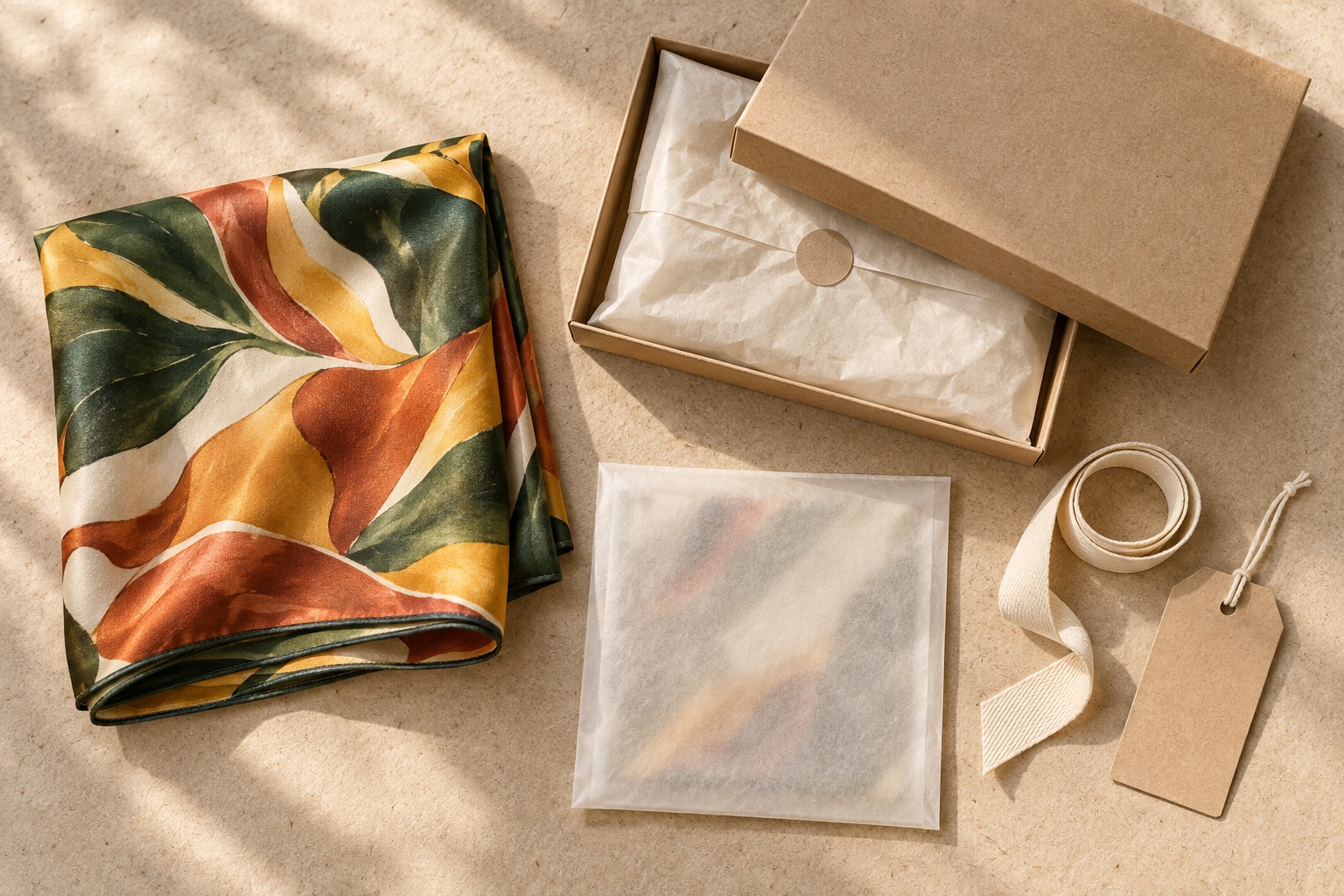
Sustainable packaging is not created by adding a single environmental symbol. It requires decisions about material quantity, sourcing, recyclability, shipping volume, durability and the claims made to customers.
Start with the protection requirement
A scarf needs protection from moisture, dust, abrasion and crushing. Map the journey from factory to freight carton, warehouse, retailer and customer. Remove layers only after confirming another layer already performs the same function.
Reduce and right-size
A smaller box uses less board and can improve carton and pallet efficiency. Avoid deep boxes that hold mostly air. Choose a folded scarf size that protects hand-rolled edges without creating unnecessary volume. A sleeve or envelope may be sufficient for some retail channels.
Simplify material combinations
Packages made from one easily separated material are generally easier for customers to sort than laminated structures, magnets, foam and mixed decorative components. If a window is needed, ask whether the film can be avoided or separated cleanly.
Evaluate recycled and certified content
Request documentation for recycled content or certified paper sourcing when these attributes support the brand’s goals. Confirm whether color, strength and print finish remain suitable. Recycled appearance should be an intentional design choice, not an assumption about environmental performance.
Control inks, coatings and finishes
Heavy lamination, glitter, foil and some coatings can complicate recycling. Use them selectively and ask suppliers for relevant technical information. Embossing, smart typography and restrained ink coverage can create a premium result with fewer material layers.
A truthful modest claim is more valuable than a broad “eco-friendly” statement that cannot be supported.
Write disposal guidance clearly
If the package is recyclable only after separating components, explain how. Requirements and recycling infrastructure vary by location, so avoid universal claims unless verified. Include symbols only when they are accurate for the material and market.
Consider reuse without overbuilding
A durable box can be kept for storage, but extra weight and material are not automatically better. Ask whether customers are likely to reuse it and whether the scarf needs long-term storage protection. Design the reuse function deliberately.
Measure the shipping effect
Compare units per master carton, carton weight and dimensional volume before final approval. A small change in retail packaging can significantly affect freight across a large order. Test the pack for transit damage so reductions do not create product waste.
Reduce volume, remove redundant layers and support every environmental claim with material information. Packaging must still protect the silk successfully.