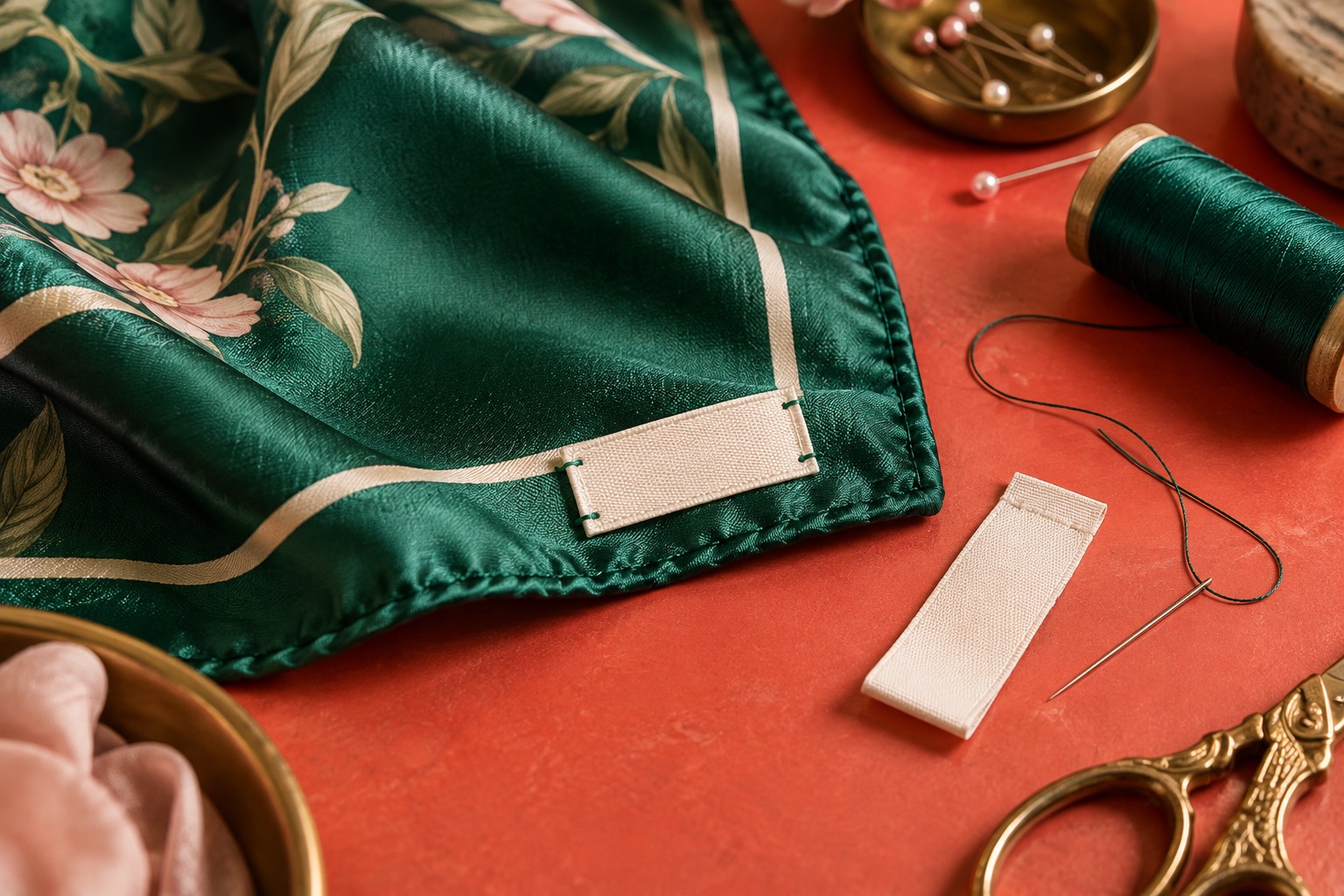
Labels are small, but their material, size and placement affect how a silk scarf feels when worn. Plan them alongside the hem and packaging rather than adding them after the sample is finished.
Brand labels
A woven label gives a dimensional textile character and can reproduce simple logos clearly. A printed label allows finer text, gradients and more colors on a smooth surface. For a minimal presentation, the brand may also appear in the scarf artwork or on packaging, leaving only required product information on the sewn label.
Care and composition information
Care labels commonly include fiber composition, cleaning instructions, country of origin and responsible business information. Requirements vary by destination market and sales channel. The brand is responsible for confirming the wording and symbols needed for the countries where the product will be sold.
Choose a material that suits silk
Soft woven edges, lightweight satin tape and fine printed materials are generally more comfortable than thick, coarse labels. Folded constructions hide cut edges, while heat-cut edges can feel firm. Touch the actual sample against the neck or wrist rather than evaluating it only on a table.
Keep the size proportionate
A large label can pull down a narrow twilly or show through chiffon. Too small, and care information becomes unreadable. Separate brand and care labels when necessary, or use a booklet fold to hold more information in a compact footprint.
Plan label placement
Corner placement is common because the label can be secured near the hem, but it may become visible in certain knots. A long scarf may use an end position. Specify the distance from the edge, the direction in which text should read and whether the label is attached on two or four sides.
Approve the label sewn into the actual scarf—not as a loose label sample alone.
Artwork for woven and printed labels
Use vector artwork where possible and respect the minimum line thickness and text size recommended by the label supplier. Simplify tiny trademark details. Confirm background, thread or ink colors with physical references, and include a proof showing front, back, folds and finished dimensions.
Quality checks
- Correct wording, symbols and fiber percentages
- Readable text and accurate logo proportions
- Soft, clean edges with no sharp corners
- Straight placement and secure stitching
- No puckering, stains or thread damage to the scarf
The best label feels like part of the scarf. Define content, construction, softness, size and placement before bulk production.