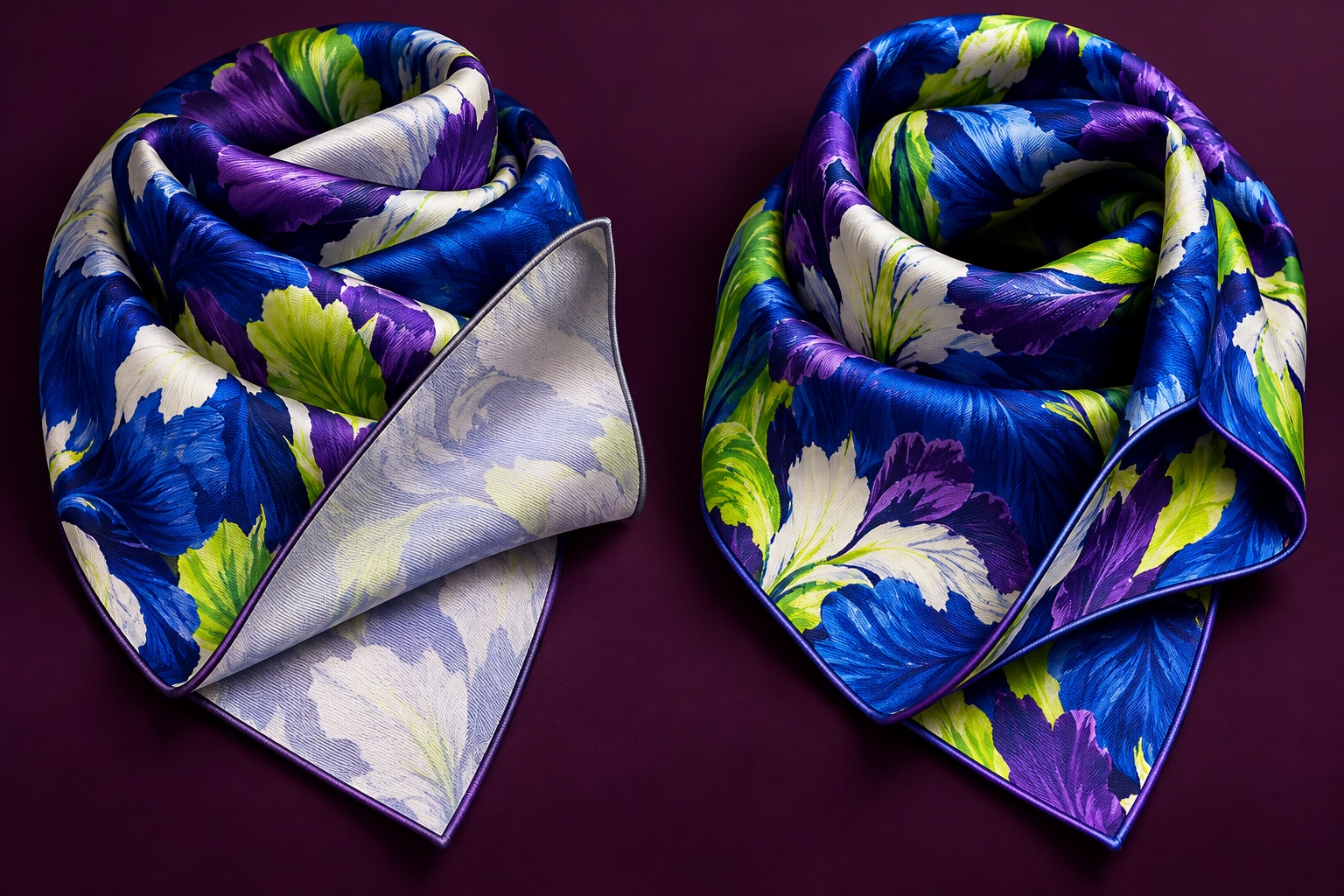
Silk scarves are often seen from both sides as they move and fold. Buyers therefore ask whether printing should be single-sided or double-sided. The right answer depends on fabric, artwork, budget and the exact appearance expected on the reverse.
What single-sided printing means
The design is applied from one face of the fabric. Dye may penetrate through the silk, especially on lighter constructions, so the reverse can still show the image. However, color on the back may appear lighter and fine details may be less defined. This is different from printing two independent sides.
Penetration is not a second print
Traditional scarf designs often rely on good color penetration to create a wearable reverse. The result can feel natural because both sides remain part of one thin piece of silk. Penetration varies with fabric density, dye, print method, color depth and finishing, which is why a sample is important.
Engineered double-sided options
Some processes are developed to improve front-to-back color consistency or place separate artwork on each face. Independent alignment becomes critical when motifs, borders or lettering must register. The method may involve specialized printing, coating or a layered construction, each with its own effect on handfeel and cost.
How fabric affects the result
Chiffon and lightweight habotai allow more visual show-through than dense twill or satin. A heavier fabric may produce a rich face but a noticeably paler reverse unless a specific process is used. Ask to see examples made on the exact silk construction you are considering.
Artwork considerations
Text and directional logos expose reversal immediately. If the back must read correctly, ordinary penetration will not solve the problem. Borders also reveal misregistration. Organic patterns, mirrored motifs and non-directional artwork are generally more forgiving than typography or precise geometric layouts.
Write the requirement as a visual outcome: “both sides similar in color” or “different readable artwork on each side.”
Questions for the sample review
- How much lighter is the reverse?
- Are small motifs and edges clean on both faces?
- Does the scarf remain soft and fluid?
- Is there any shift between front and back artwork?
- Do folds reveal an acceptable transition?
Choosing the practical option
For many silk scarves, a well-printed face with controlled penetration is the most elegant balance. Choose an engineered double-sided method only when the design and use case justify the added development. Compare samples in motion, not just laid flat.
Define the reverse-side expectation precisely. Fabric penetration, similar color on both faces and two different registered designs are separate technical goals.