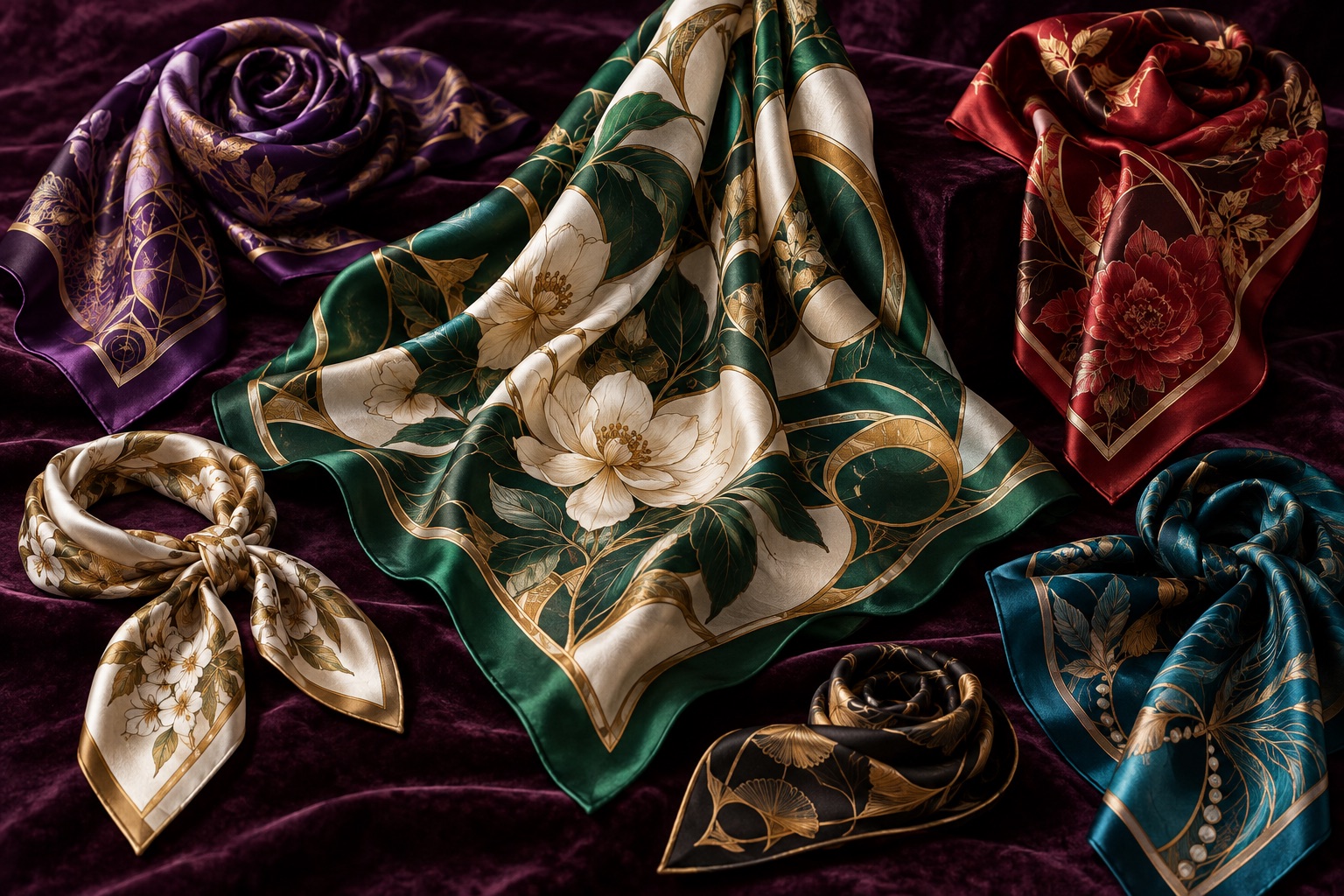
A collection should feel larger than a set of unrelated prints. It needs a shared point of view, a clear customer and enough commercial structure to make sampling, production and merchandising practical.
Define the customer and occasion
Decide who will wear the scarves, how they dress and why they are buying. A collectible art scarf, an everyday neck square and a formal gift serve different needs. This decision guides size, silk, palette, packaging and retail price.
Create a format architecture
Start with one hero size and add only formats that have a distinct role. A large square carries narrative artwork, a compact square supports everyday styling and a twilly offers an accessible add-on. Too many dimensions create separate artwork, cutting and packaging decisions.
Build a visual system
Choose recurring elements that connect the collection: border proportions, corner treatment, line quality, signature color or typography. Individual designs can tell different stories while still looking like members of one brand family.
Plan colorways with purpose
Every colorway should reach a real customer or styling need. Use a balanced range of light, dark, neutral and accent-led options rather than producing arbitrary variations. Confirm that the same artwork remains legible and attractive in each palette.
Set a material hierarchy
A collection may use one consistent silk for clarity or two carefully defined levels. Keep the core construction stable when comparing design performance. If satin, twill and chiffon are mixed, make the reason visible in styling and product story.
Coherence comes from repeated decisions, not from making every scarf look the same.
Sample the collection as a group
Review individual color and detail, then place all samples together. Check whether one piece dominates, whether palettes compete and whether the assortment contains enough contrast. Photograph the group under consistent light to support line review and merchandising.
Connect product and packaging
Use packaging that fits the format architecture. Standard box sizes, tissue and insert systems reduce unnecessary complexity. Product names, labels and barcodes should distinguish designs and colorways without weakening the premium presentation.
Work backward from launch
Include artwork finalization, strike-offs, scarf samples, photography, bulk production, inspection, freight and inventory receiving. Schedule photography samples early when possible, but make sure they match the final approved production specification.
Begin with a clear customer, one hero format and a repeatable visual system. Add options only when they strengthen the assortment and can be produced coherently.