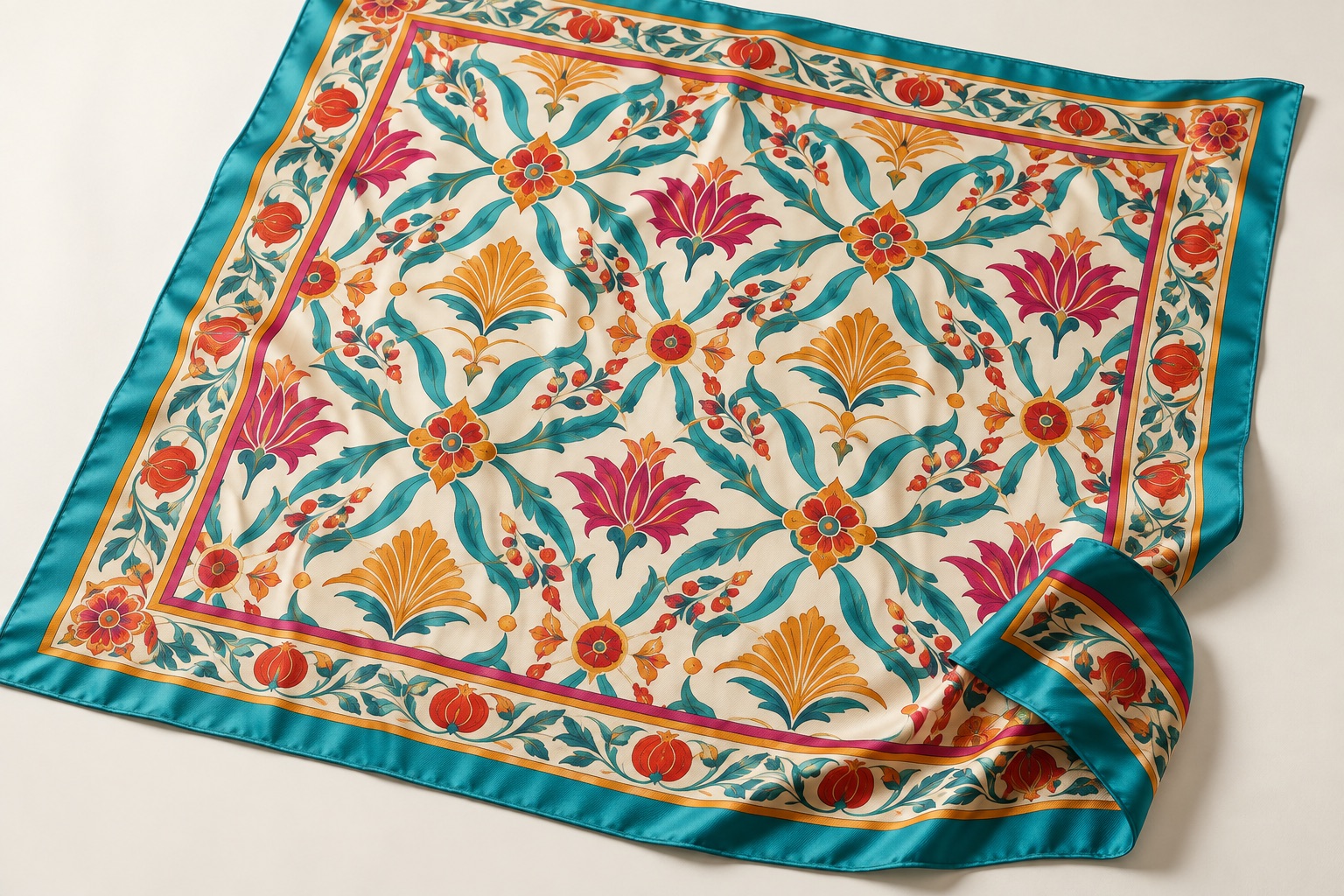
Repeating artwork can create a continuous field, but a silk scarf is not simply a length of printed fabric. It is a defined object with visible borders, corners and many possible folds. Design the repeat in relation to that final shape.
Choose repeat scale from wearing distance
A motif that looks rich on a monitor may disappear when the scarf is folded into a narrow band. Print a paper section at actual size and view it from arm’s length. Include both recognizable forms and smaller linking elements so the design remains lively at several fold widths.
Decide whether the repeat should be obvious
A straight repeat creates a clear grid. Half-drop and brick repeats can hide alignment and feel more organic. Tossed motifs introduce movement but still need careful spacing. The right structure depends on whether the brand wants geometry, rhythm or an apparently seamless surface.
Test the tile edges
Duplicate the repeat tile in a grid and inspect every join. Look for unintended vertical or horizontal lines, crowded corners and empty channels. Temporarily desaturating the artwork can make density problems easier to see. Avoid repairing gaps with last-minute motifs that create new clusters elsewhere.
Coordinate the repeat with the scarf border
If the design has a border, choose whether the field ends cleanly, overlaps or sits behind it. Keep essential motifs away from the hem allowance and expected cutting tolerance. A thin keyline can reveal small alignment differences more readily than a generous border, so use precision lines deliberately.
Plan for orientation
Directional motifs such as faces, lettering, animals or architecture may appear upside down from one edge. Four-way or mirrored arrangements make the scarf easier to style. If a single orientation is essential, decide which corner will be featured and how the scarf is likely to be folded.
Make a small paper scarf, fold it several ways and check which fragments become the visual focus.
Use color to support the repeat
Strong contrast makes spacing and alignment more visible. Tonal color can soften a mechanical grid. Check the repeat in every planned colorway rather than assuming the same balance will transfer. A dark ground may close small gaps that look open on a pale version.
Prepare the production file
Supply the clean repeat tile and a full scarf layout showing intended scale, border and orientation. Convert or package linked artwork correctly, name spot colors clearly and include a reference image. Keep a version with editable layers so corrections do not require rebuilding the design.
A successful repeat has no accidental seams and still looks intentional when folded. Test actual scale, edges, border relationships and orientation before sampling on silk.